Freelance vs Employee: Which Actually Pays More in 2026?

We did the math on benefits, taxes, hours, and stability. The answer is more nuanced than you'd think — and depends heavily on your tax bracket.
"Should I go freelance?" is the wrong question. The right question is: at your income level, in your industry, with your risk tolerance — which model nets you more after taxes, benefits, and time?
We built a complete comparison model using 2026 tax brackets, average freelance rates by industry, and real employer benefit costs. The answer is more nuanced than either side admits.
$95K
Median employee salary
Tech industry, US (2026)
$115K
Median freelancer gross
Same skill level, full-time
15.3%
Self-employment tax
Social Security + Medicare
$12K–$28K
Hidden benefit value
Health, 401k, PTO employers pay
The raw numbers: salary vs. freelance gross
At first glance, freelancers earn more — but that number is deceiving. A freelancer billing $60/hour for 40 hours a week grosses $124,800. An employee at the same company earning $95,000 seems to earn less. But the employee gets benefits worth $15,000–$25,000 that the freelancer must buy themselves.
| Line item | Employee ($95K) | Freelancer ($125K gross) | Difference |
|---|---|---|---|
| Gross income | $95,000 | $124,800 | +$29,800 freelance |
| Federal income tax | –$14,768 | –$20,694 | –$5,926 freelance |
| State tax (avg) | –$4,750 | –$6,240 | –$1,490 freelance |
| Self-employment tax | $0 | –$17,640 | –$17,640 freelance |
| Health insurance | –$1,800 (employer subsidized) | –$7,200 (own plan) | –$5,400 freelance |
| Retirement (401k match) | +$4,750 (employer match) | $0 | –$4,750 freelance |
| PTO value (15 days) | +$5,480 (paid time off) | $0 (unpaid days) | –$5,480 freelance |
| Net take-home | $83,912 | $73,026 | –$10,886 freelance |
The self-employment tax surprise
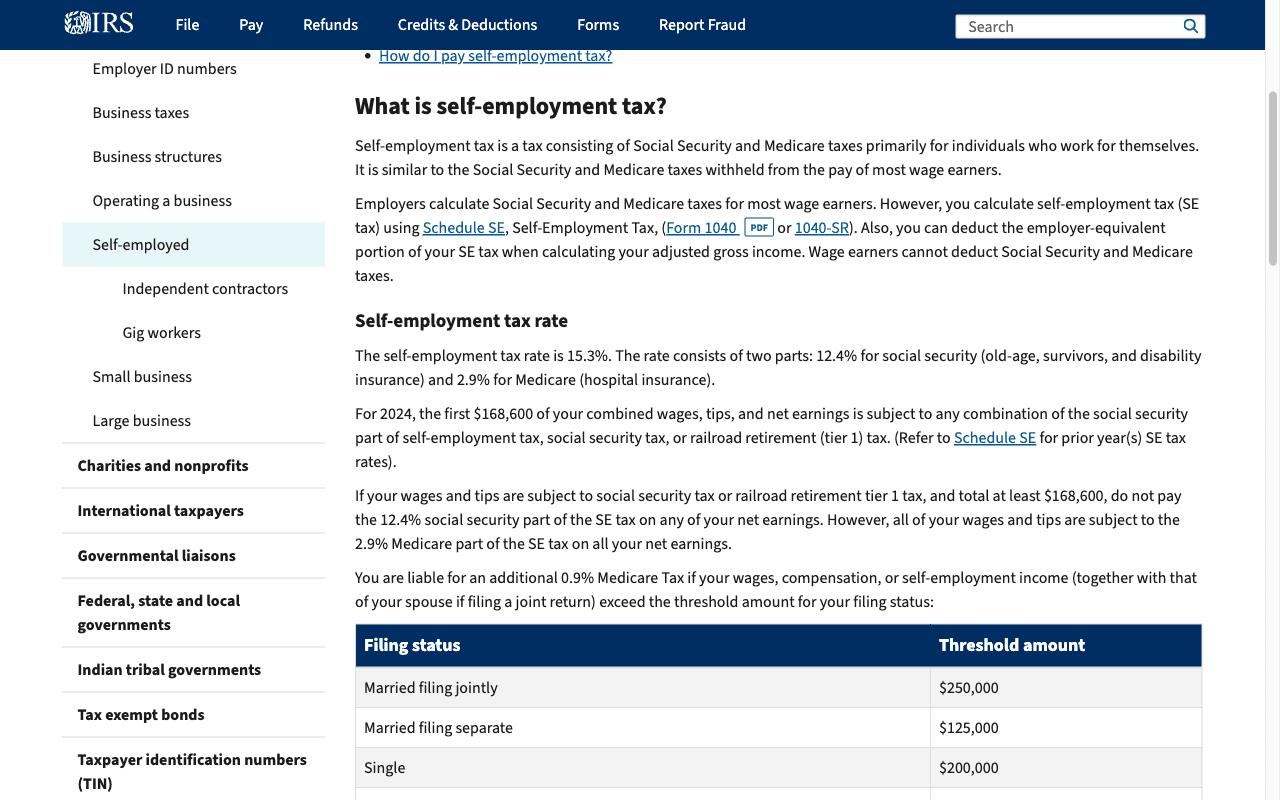
Most new freelancers forget about the 15.3% self-employment tax (Social Security 12.4% + Medicare 2.9%). As an employee, your employer pays half. As a freelancer, you pay the full amount. On $125K income, that is $17,640 that employees never see.
The crossover point: when freelance wins
Freelancing becomes financially superior at higher income levels where you can leverage business deductions, the Qualified Business Income (QBI) deduction, and S-Corp election to reduce self-employment tax.
| Employee salary equivalent | Freelancer break-even gross | Premium needed | Verdict |
|---|---|---|---|
| $50,000 | $58,000 | +16% | Close — depends on benefits |
| $75,000 | $98,000 | +31% | Freelance needs to charge significantly more |
| $100,000 | $135,000 | +35% | Possible but need strong pipeline |
| $150,000 | $185,000 | +23% | S-Corp election helps a lot here |
| $200,000+ | $230,000 | +15% | Freelance wins with tax optimization |
Find your freelance break-even rate
Enter the take-home pay you'd need to match your salary, your realistic billable hours, and overhead — the calculator returns the hourly rate you must charge to break even.
Your inputs
Set your income goal and availability to find your ideal rate.
Your hourly rate
$89/hr
Minimum to hit your income goal
The S-Corp hack at $150K+
Once you earn $80K+ as a freelancer, forming an S-Corp and paying yourself a "reasonable salary" of $60K–$80K saves $5,000–$15,000/year in self-employment tax. Your accountant costs $1,500–$3,000/year — the ROI is immediate. This is the single biggest tax optimization available to freelancers.
The non-financial factors
| Factor | Employee advantage | Freelance advantage |
|---|---|---|
| Schedule flexibility | Predictable but rigid | Total control (huge for parents) |
| Income stability | Predictable paycheck | Variable; feast-or-famine cycles |
| Career growth | Clear ladder; mentorship | Unlimited ceiling; you choose direction |
| Social connection | Built-in team and culture | Can be isolating; requires effort |
| Skill development | Company pays for training | You invest in yourself |
| Work-life boundary | Easier to 'clock out' | Harder to stop working |
| Geographic freedom | Office-dependent (often) | Work from anywhere |
| Layoff risk | One employer = one risk | Multiple clients = diversified risk |
Our recommendation
If you earn under $100K — staying employed is almost certainly better financially. The benefit value gap is too large for freelance rates to overcome unless you are in a very high-demand niche. Instead, keep your job and start a side hustle to build freelance skills and income before making the leap.
If you earn $100K–$150K — freelancing can work if you have a strong pipeline and are willing to handle the business side (invoicing, taxes, insurance). The S-Corp election starts making sense here.
If you earn $150K+ — freelancing is often financially superior, especially with proper tax structuring. At this level, the freedom and earning ceiling usually outweigh the stability benefits of employment.
The hybrid approach — the smartest move for most people is to start freelancing as a side hustle while employed. Build your client base, validate your rates, and only go full-time freelance when your side income consistently covers 80%+ of your salary. This eliminates the scariest part of the transition: the income gap.
Frequently asked questions
After taxes and benefits, who actually earns more — freelancer or employee?+
Rule of thumb: a freelance hourly rate needs to be 1.4–1.5x your equivalent W-2 hourly rate just to break even on taxes, healthcare, and lost employer benefits. Above that, freelancers come out ahead; below it, the W-2 wins on take-home.
How much is self-employment tax in the US?+
15.3% on the first $168,600 of net earnings (2026) — that's both halves of Social Security and Medicare. As a W-2 employee, your employer pays half of this for you. Half of your SE tax is itself deductible above-the-line.
How much should freelancers budget for health insurance?+
$400–$1,500/month for individual coverage on the ACA marketplace, depending on state and income. Healthcare alone often justifies a 20–30% rate premium over W-2 equivalents. Health Sharing Ministries are cheaper but aren't insurance and may decline expensive claims.
What retirement plans can freelancers use?+
Solo 401(k) lets you contribute up to $23,000 (employee) + 25% of net SE income (employer side), capped around $69,000 in 2026. SEP-IRA is simpler and allows ~25% of SE income. Both are far more generous than employee 401(k) limits.
When does it make more sense to stay a W-2 employee?+
When your role offers above-market benefits (RSUs, generous 401(k) match, premium health plans, parental leave), when your work isn't easily marketable to other clients, or when you'd lose specialty income (commissions, equity vesting). Stability has real cash value.
Should I do freelance work on the side while keeping my W-2?+
For most people, yes — at least until freelance income consistently covers 6 months of expenses. Hybrid earners get employer benefits + portfolio income + a tested income stream. Just check your employment contract for moonlighting clauses and IP-assignment rules.